




About Us
《紅樓夢》的味覺思維 Taste as Experience and Metaphor in The Dream of the Red Chamber
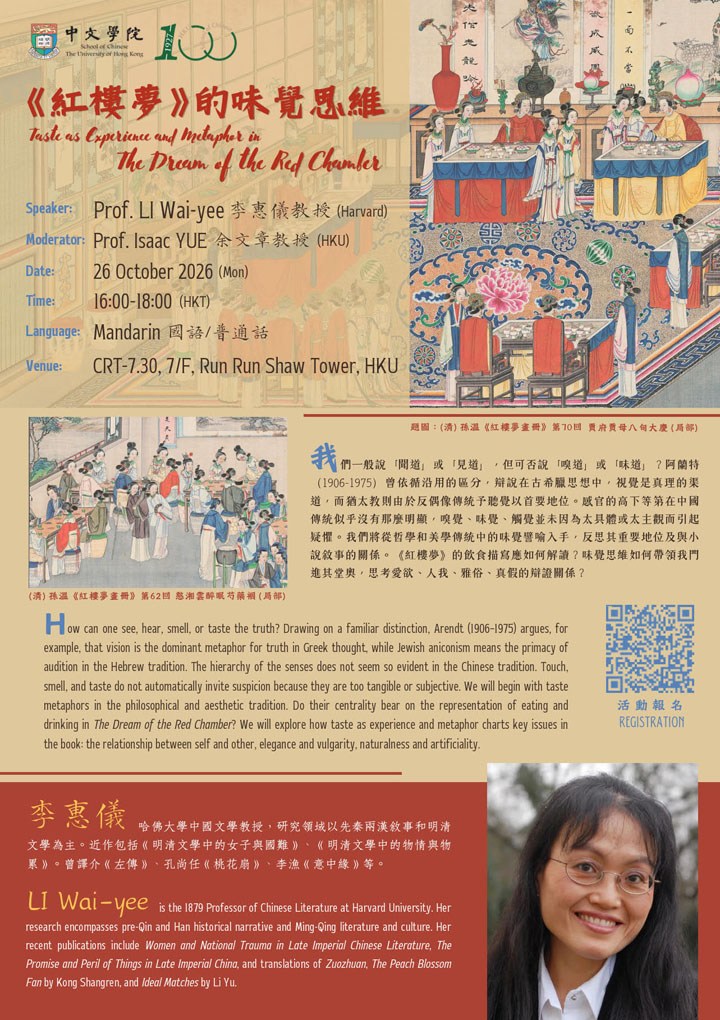
2026/27 School of Chinese Scholar Seminar
《紅樓夢》的味覺思維
Taste as Experience and Metaphor in The Dream of the Red Chamber
分享嘉賓 Speaker: 李惠儀 教授 Prof. LI Wai-yee
(Department of East Asian Languages and Civilizations, Harvard University)
主持人 Moderator: 余文章 教授 Prof. YUE Man Cheung, Isaac
(School of Chinese, HKU)
日期時間 Date & Time: October 26, 2026 (Mon) 16:00-18:00 (HKT)
語言 Language: 國語/普通話 Mandarin
地點 Venue: 香港大學百周年校園逸夫教學樓7樓730室
CRT-7.30, 7/F, Run Run Shaw Tower, Centennial Campus, HKU
講座模式 Delivery Mode: Face-to-face & Online (via Zoom)
報名 Registration:
https://hku.au1.qualtrics.com/jfe/form/SV_9yOrO6dHaUVX2Rg
摘要 Abstract:
我們一般說「聞道」或「見道」,但可否說「嗅道」或「味道」?阿蘭特(1906-1975)曾依循沿用的區分,辯說在古希臘思想中,視覺是真理的渠道,而猶太教則由於反偶像傳統予聽覺以首要地位。感官的高下等第在中國傳統似乎沒有那麼明顯,嗅覺、味覺、觸覺並未因為太具體或太主觀而引起疑懼。我們將從哲學和美學傳統中的味覺譬喻入手,反思其重要地位及與小說敘事的關係。《紅樓夢》的飲食描寫應如何解讀?味覺思維如何帶領我門進其堂奧,思考愛欲、人我、雅俗、真假的辯證關係?
How can one see, hear, smell, or taste the truth? Drawing on a familiar distinction, Arendt (1906–1975) argues, for example, that vision is the dominant metaphor for truth in Greek thought, while Jewish aniconism means the primacy of audition in the Hebrew tradition. The hierarchy of the senses does not seem so evident in the Chinese tradition. Touch, smell, and taste do not automatically invite suspicion because they are too tangible or subjective. We will begin with taste metaphors in the philosophical and aesthetic tradition. Do their centrality bear on the representation of eating and drinking in The Dream of the Red Chamber? We will explore how taste as experience and metaphor charts key issues in the book: the relationship between self and other, elegance and vulgarity, naturalness and artificiality.
講者簡介 About the Speaker:
李惠儀 哈佛大學中國文學教授,研究領域以先秦兩漢敘事和明清文學為主。近作包括《明清文學中的女子與國難》、《明清文學中的物情與物累》。曾譯介《左傳》、孔尚任《桃花扇》、李漁《意中緣》等。
LI Wai-yee is the 1879 Professor of Chinese Literature at Harvard University. Her research encompasses pre-Qin and Han historical narrative and Ming-Qing literature and culture. Her recent publications include Women and National Trauma in Late Imperial Chinese Literature, The Promise and Peril of Things in Late Imperial China, and translations of Zuozhuan, The Peach Blossom Fan by Kong Shangren, and Ideal Matches by Li Yu.
Notice:
1) The seminar will be conducted primarily in a face-to-face mode; Those who cannot attend the seminar in-person could apply for online participation (via Zoom);
2) All those who would like to attend the seminar are required to register online (Click HERE) on a first-come, first-served basis;
3) Email of confirmation will be sent to the registered email addresses and participants have to show the screenshot or print-out version of the email for entry of the seminar venue;
4) Walk-in or late-comers will not be allowed for entry of the seminar venue unless situation allows.
ALL are welcome*
*Pre-registration (Click HERE) is required.
