




About Us
[Call for Papers]The Body That Does Not Quite Fit In Bodies, Bodily Practices, and Negotiation in China and Beyond
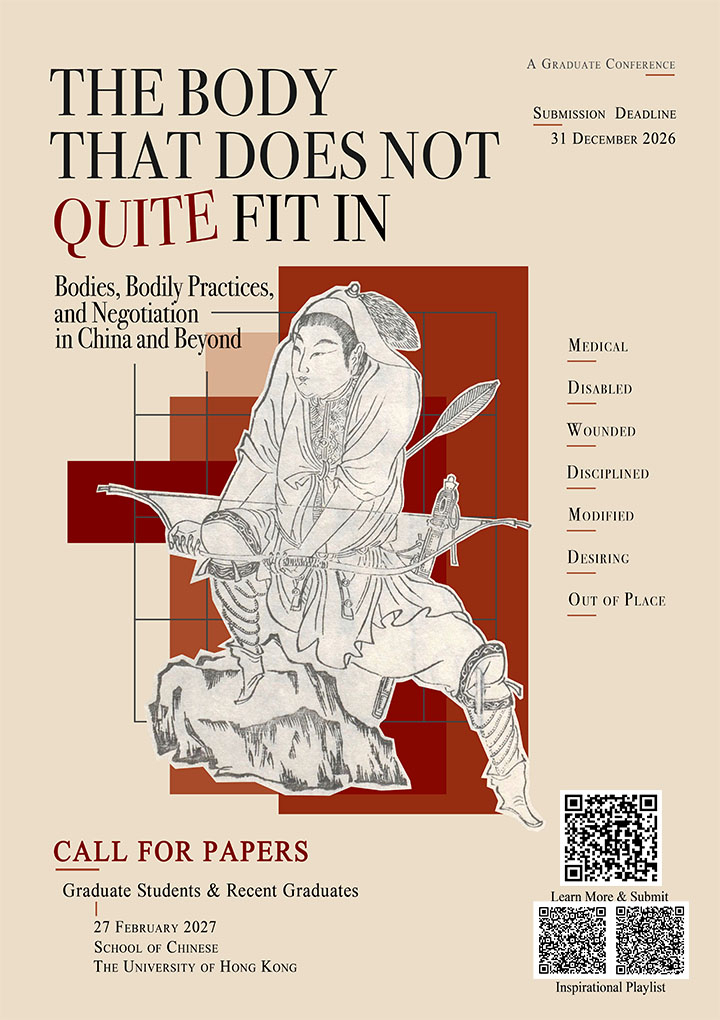
School of Chinese .Graduate Conference · 27 February 2027
The Body That Does Not Quite Fit In
Bodies, Bodily Practices, and Negotiation in China and Beyond
School of Chinese, The University of Hong Kong
About the Conference
The body moves, suffers, changes, and encounters the world. In doing so, it navigates physical and social environments and negotiates the spaces, expectations, and categories surrounding it, sometimes accommodating them, sometimes exceeding them, and sometimes making them hard to sustain. Rather than viewing the body that does not quite fit in simply as a problem to be solved or a condition to be corrected, we invite participants to look closely at those moments and consider what the body itself does, experiences, and makes possible, as well as the conversations that gather around it. We ask what becomes visible when the body exceeds, blurs, complicates, or does not quite correspond to the categories through which it is understood, and what bodily practices can reveal about the cultural, social, and material structures within which the body inhabits and through which it becomes intelligible, acceptable, or out of place.
We welcome papers that treat the body as a primary object of inquiry and attend to its material, sensory, affective, spatial, social, cultural, and experiential dimensions. We particularly welcome humanities-oriented and historically grounded approaches. Theoretical approaches are encouraged when they shed light on historically specific bodies, bodily practices, and bodily experiences. We invite submissions from graduate students and recent graduates working across literature, history, art history, media studies, cultural studies, gender and sexuality studies, medical humanities, and related fields. Papers may focus on a particular period, region, genre, community, or bodily practice; comparative approaches across periods and regions are welcome but not required.
Possible Topics
The following themes are intended as points of departure rather than an exhaustive list. Submissions may engage with more than one theme.
The Medical Body
Bodies in pain or illness, as well as bodily experiences of diagnosis, treatment, care, healing, aging, and physical vulnerability.
The Disabled Body
Bodily difference, disability, dependence, mobility, sensory experience, accessibility, and encounters between bodies and their environments.
The Wounded Body
Bodies marked by injury, violence, abuse, and other forms of bodily harm; their varied responses to harm, including struggle, escape, withdrawal, freezing, appeasement, or calls for help; as well as bodily aftermath and persistence of injury, including pain, scars, healing, self-care, memory, recognition, self-perception, victimhood, recovery, survival, and the traces that refuse to leave.
The Disciplined Body
Bodies trained, cultivated, restrained, corrected, or expected to perform particular social and cultural roles; and bodies that struggle, fail, adapt, or exceed those expectations.
The Modified Body
Bodies altered through clothing, hairstyle, cosmetics, tattooing, piercing, medical intervention, or other forms of bodily modification, as well as the praise, criticism, anxiety, fear, or fascination surrounding such changes.
The Desiring Body
Bodies that desire, seek pleasure, and act upon their desires in ways that complicate, negotiate, or unsettle expectations surrounding gender, sexuality, propriety, social norms, bodily conduct, or subjectivity.
The Body Out of Place
Bodies that do not quite fit the spaces, roles, identities, or categories assigned to them, including questions of gender, sexuality, ethnicity, race, religion, status, and belonging.
Submission Guidelines
Please prepare your proposal in Chinese or English and submit it in WORD or PDF format to ruochenqin@connect.hku.hk.
Each proposal must include the following items in the order listed:
- Title
- Abstract: Maximum 300 English words or 600 Chinese Characters
- Keywords: 3-5 keywords
- Short biography: Maximum 50 English words or 100 Chinese characters, including your name, professional status, and affiliation (e.g., PhD candidate, The University of Hong Kong), etc.
Important Dates:
- Deadline for abstract submission: 31 December 2026
- Notification of acceptance: 14 January 2027
- Conference date: 27 February 2027 at HKU
