




About Us
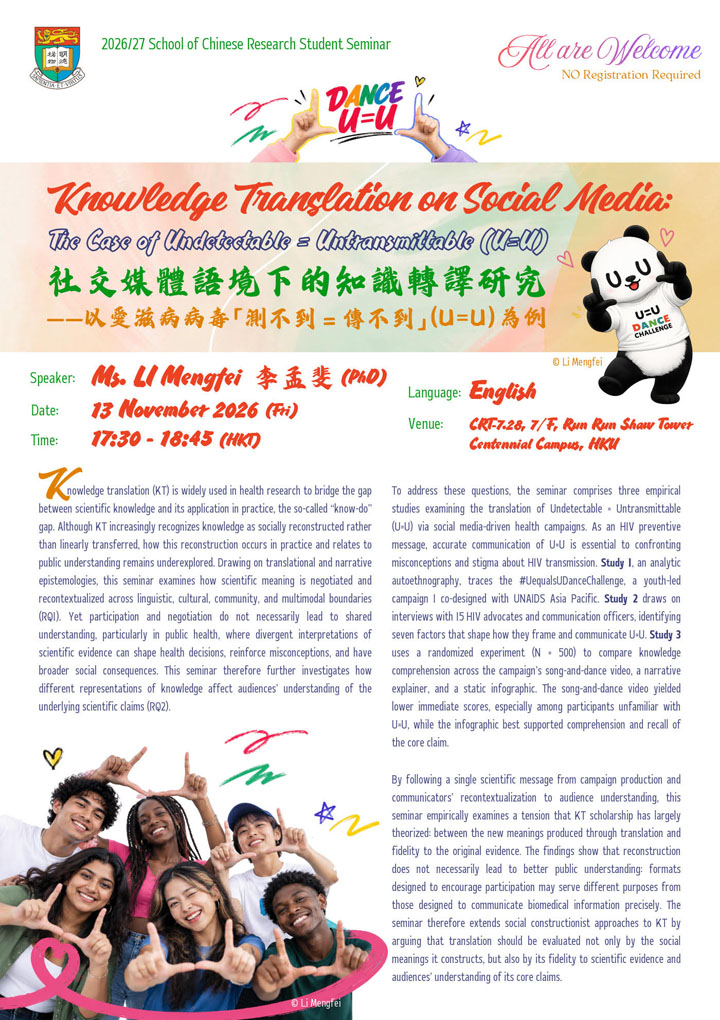
Knowledge Translation on Social Media: The Case of Undetectable = Untransmittable (U=U) 社交媒體語境下的知識轉譯研究——以愛滋病病毒「測不到=傳不到」(U=U)為例
2026/27 School of Chinese Research Student Seminar
Knowledge Translation on Social Media: The Case of Undetectable = Untransmittable (U=U)
社交媒體語境下的知識轉譯研究——以愛滋病病毒「測不到=傳不到」(U=U)為例
Speaker: Ms. LI Mengfei 李孟斐 (PhD)
Date & Time: November 13, 2026 (Fri) 17:30-18:45 (HKT)
Language: English
Venue: CRT-7.28, 7/F, Run Run Shaw Tower, Centennial Campus, HKU
Mode of Delivery: Face-to-face
Abstract:
Knowledge translation (KT) is widely used in health research to bridge the gap between scientific knowledge and its application in practice, the so-called “know-do” gap. Although KT increasingly recognizes knowledge as socially reconstructed rather than linearly transferred, how this reconstruction occurs in practice and relates to public understanding remains underexplored. Drawing on translational and narrative epistemologies, this seminar examines how scientific meaning is negotiated and recontextualized across linguistic, cultural, community, and multimodal boundaries (RQ1). Yet participation and negotiation do not necessarily lead to shared understanding, particularly in public health, where divergent interpretations of scientific evidence can shape health decisions, reinforce misconceptions, and have broader social consequences. This seminar therefore further investigates how different representations of knowledge affect audiences’ understanding of the underlying scientific claims (RQ2).
To address these questions, the seminar comprises three empirical studies examining the translation of Undetectable = Untransmittable (U=U) via social media-driven health campaigns. As an HIV preventive message, accurate communication of U=U is essential to confronting misconceptions and stigma about HIV transmission. Study 1, an analytic autoethnography, traces the #UequalsUDanceChallenge, a youth-led campaign I co-designed with UNAIDS Asia Pacific. Study 2 draws on interviews with 15 HIV advocates and communication officers, identifying seven factors that shape how they frame and communicate U=U. Study 3 uses a randomized experiment (N = 500) to compare knowledge comprehension across the campaign’s song-and-dance video, a narrative explainer, and a static infographic. The song-and-dance video yielded lower immediate scores, especially among participants unfamiliar with U=U, while the infographic best supported comprehension and recall of the core claim.
By following a single scientific message from campaign production and communicators’ recontextualization to audience understanding, this seminar empirically examines a tension that KT scholarship has largely theorized: between the new meanings produced through translation and fidelity to the original evidence. The findings show that reconstruction does not necessarily lead to better public understanding: formats designed to encourage participation may serve different purposes from those designed to communicate biomedical information precisely. The seminar therefore extends social constructionist approaches to KT by arguing that translation should be evaluated not only by the social meanings it constructs, but also by its fidelity to scientific evidence and audiences’ understanding of its core claims.
ALL are welcome*
*NO Pre-registration is requested.
 社交媒體語境下的知識轉譯研究——以愛滋病病毒「測不到=傳不到」(U=U)為例.jpg)