
About Us
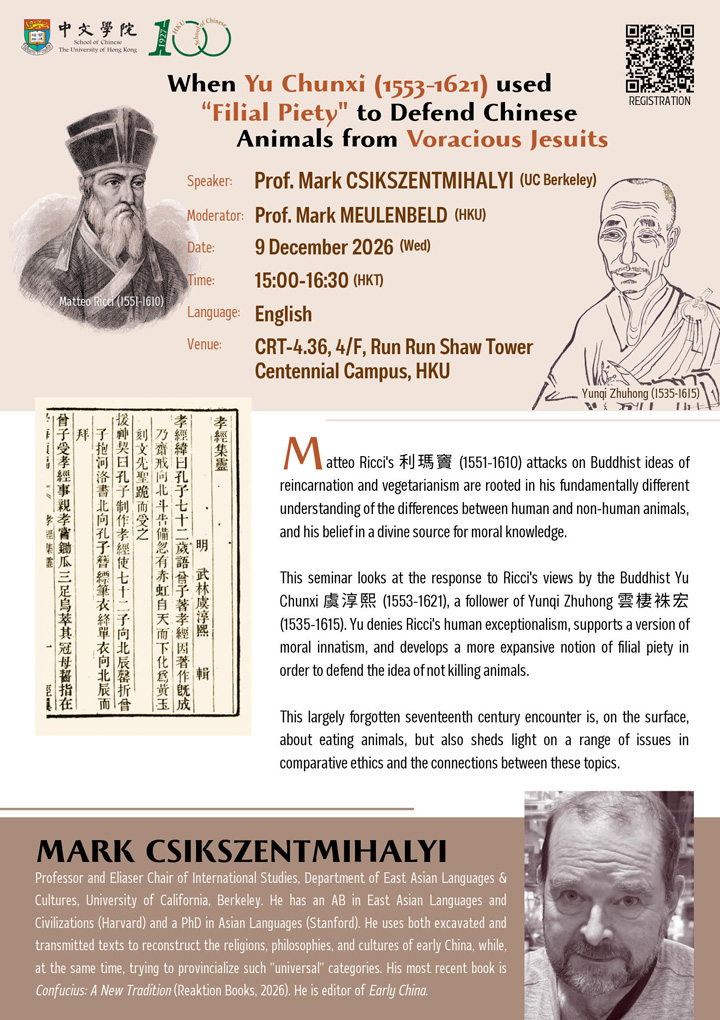
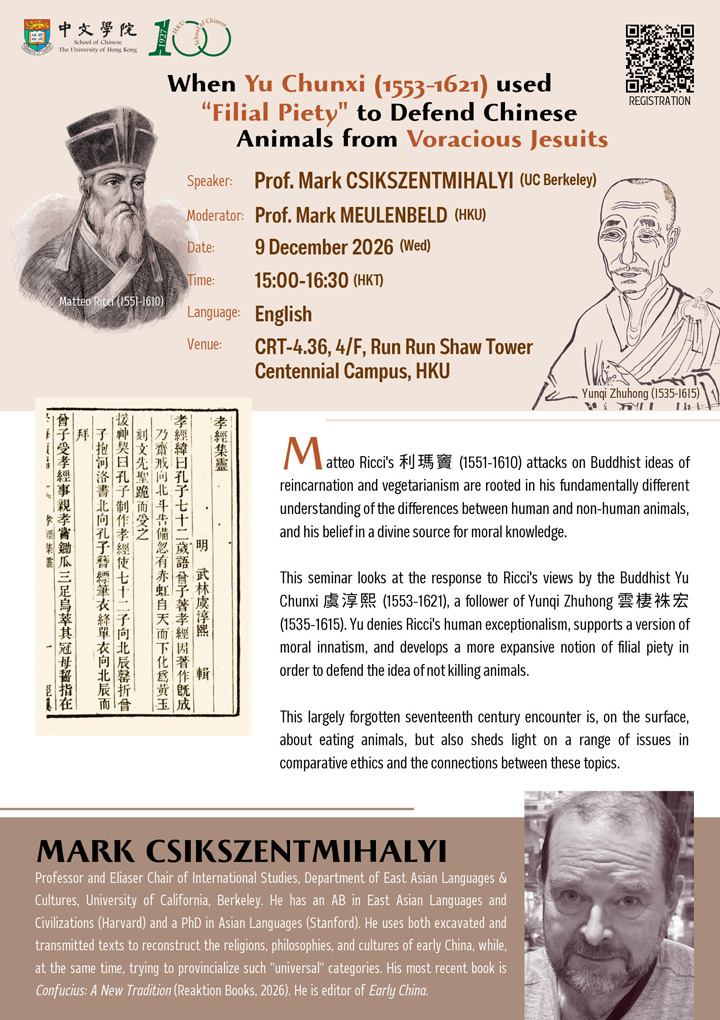
When Yu Chunxi 虞淳熙 (1553-1621) used "Filial Piety" to Defend Chinese Animals from Voracious Jesuits
2026/27 School of Chinese Scholar Seminar
When Yu Chunxi 虞淳熙 (1553-1621) used "Filial Piety"
to Defend Chinese Animals from Voracious Jesuits
Speaker:
Prof. Mark CSIKSZENTMIHALYI
(Department of East Asian Languages & Cultures, University of California, Berkeley)
Moderator:
Prof. Mark MEULENBELD
(School of Chinese, HKU)
Date & Time: December 9, 2026 (Wed) 15:00-16:30 (HKT)
Language: English
Venue: CRT-4.36, 4/F, Run Run Shaw Tower, Centennial Campus, HKU
Delivery Mode: Face-to-face & Online (via Zoom)
Registration:
https://hku.au1.qualtrics.com/jfe/form/SV_afMpSNsQZ4iZMF0
Abstract:
Matteo Ricci's 利瑪竇 (1551-1610) attacks on Buddhist ideas of reincarnation and vegetarianism are rooted in his fundamentally different understanding of the differences between human and non-human animals, and his belief in a divine source for moral knowledge. This seminar looks at the response to Ricci's views by the Buddhist Yu Chunxi 虞淳熙 (1553-1621), a follower of Yunqi Zhuhong 雲棲袾宏 (1535-1615). Yu denies Ricci's human exceptionalism, supports a version of moral innatism, and develops a more expansive notion of filial piety in order to defend the idea of not killing animals. This largely forgotten seventeenth century encounter is, on the surface, about eating animals, but also sheds light on a range of issues in comparative ethics and the connections between these topics.
About the Speaker:
Mark CSIKSZENTMIHALYI is Professor and Eliaser Chair of International Studies, Department of East Asian Languages & Cultures, University of California, Berkeley. He has an AB in East Asian Languages and Civilizations (Harvard) and a PhD in Asian Languages (Stanford). He uses both excavated and transmitted texts to reconstruct the religions, philosophies, and cultures of early China, while, at the same time, trying to provincialize such "universal" categories. His most recent book is Confucius: A New Tradition (Reaktion Books, 2026). He is editor of Early China.
Notice:
1) The seminar will be conducted primarily in a face-to-face mode; Those who cannot attend the seminar in-person could apply for online participation (via Zoom);
2) All those who would like to attend the seminar are required to register online (Click HERE) on a first-come, first-served basis;
3) Email of confirmation will be sent to the registered email addresses and participants have to show the screenshot or print-out version of the email for entry of the seminar venue;
4) Walk-in or late-comers will not be allowed for entry of the seminar venue unless situation allows.
ALL are welcome*
*Pre-registration (Click HERE) is required.